Based on our experience in protein crystallization under simulated microgravity conditions, we have been able to directly analyze the effects of this environment on the physicochemical processes involved in nucleation and crystal growth. In this context, BioTechCell S.A.C. has developed a proprietary and unique simulated microgravity method, which enables the reproduction and controlled modulation of reduced gravitational conditions for the study of multiple physicochemical and biological systems, extending beyond protein crystallization alone.
Protein crystallization is a key process in biochemistry and biotechnology, as it enables detailed investigation of the three-dimensional structure of biomolecules through techniques such as X-ray crystallography (Vélasquez-González & Amézquita-Morataya, 2022). Understanding protein structures is fundamental for drug discovery, enzyme engineering, and structural biology research (DeLucas et al., 1989). In this regard, microgravity represents a critical factor capable of significantly influencing protein crystallization, as it reduces gravitational forces and alters nucleation and crystal growth mechanisms (McPherson et al., 1991).
Several studies have demonstrated that microgravity improves protein crystal quality by reducing structural defects and promoting enhanced molecular organization (DeLucas et al., 1989; Lin & Li, 2018). Under terrestrial conditions, phenomena such as sedimentation and convection affect crystal formation, often leading to structural imperfections; however, in microgravity environments, these effects are minimized, enabling the formation of more homogeneous and higher-quality crystals (McPherson et al., 1991; Lin & Li, 2018).
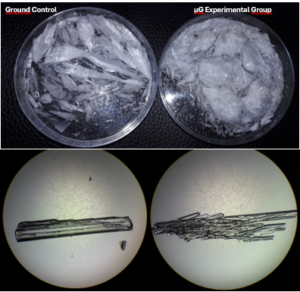
Our studies on the crystallization of potassium nitrate (KNO₃) under simulated microgravity conditions have provided a robust experimental model for optimizing protein crystallization, as both processes share fundamental physicochemical principles related to mass transport, molecular diffusion, and crystal growth (Lin & Li, 2018). Under microgravity conditions, the absence of convection and the dominance of diffusion alter solute transport within solution, directly influencing crystal size, purity, and structural perfection (McPherson et al., 1991).
These advances are particularly relevant to the pharmaceutical industry, as the production of high-quality protein crystals enables improved structural resolution and enhances rational drug design by allowing more precise characterization of interactions with biological targets (DeLucas et al., 1989; Vélasquez-González & Amézquita-Morataya, 2022). Furthermore, the controlled crystallization of inorganic compounds such as KNO₃ has allowed the refinement of experimental parameters that are transferable to biomolecular crystallization, opening new avenues for applications in biochemistry, pharmacology, and structural biology (Lin & Li, 2018).
Through this development, BioTechCell S.A.C. positions itself at the forefront of biotechnology and microgravity research, with significant potential to contribute to scientific advancement, technological innovation, and future applications in the pharmaceutical industry and space exploration (DeLucas et al., 1989; McPherson et al., 1991).
References
- McPherson, A., Greenwood, A., & Day, J. (1991). The effect of microgravity on protein crystal growth. Advances in Space Research, 11(7), 343-356.
- McPherson, A. (1993). Effects of a microgravity environment on the crystallization of biological macromolecules. Microgravity science and technology, 6(2), 101-109.
- DeLucas, L. J., Smith, C. D., Smith, H. W., Vijay-Kumar, S., Senadhi, S. E., Ealick, S. E., … & Bugg, C. E. (1989). Protein crystal growth in microgravity. Science, 246(4930), 651-654.
- Yu, Y., Li, K., Lin, H., & Li, J. C. (2018). The study of the mechanism of protein crystallization in space by using microchannel to simulate microgravity environment. Crystals, 8(11), 400.
- Timofeev, V., & Samygina, V. (2023). Protein crystallography: achievements and challenges. Crystals, 13(1), 71.
- Vélasquez-González, O. E., & Amézquita-Morataya, L. (2022). Cristalogénesis biológica y cristalografía en la elucidación de la estructura tridimensional de las proteínas. Revisión narrativa. Ciencia, Tecnología y Salud, 9(2), 199-214.
 Spanish
  English